 North Country Organics
Stress-X

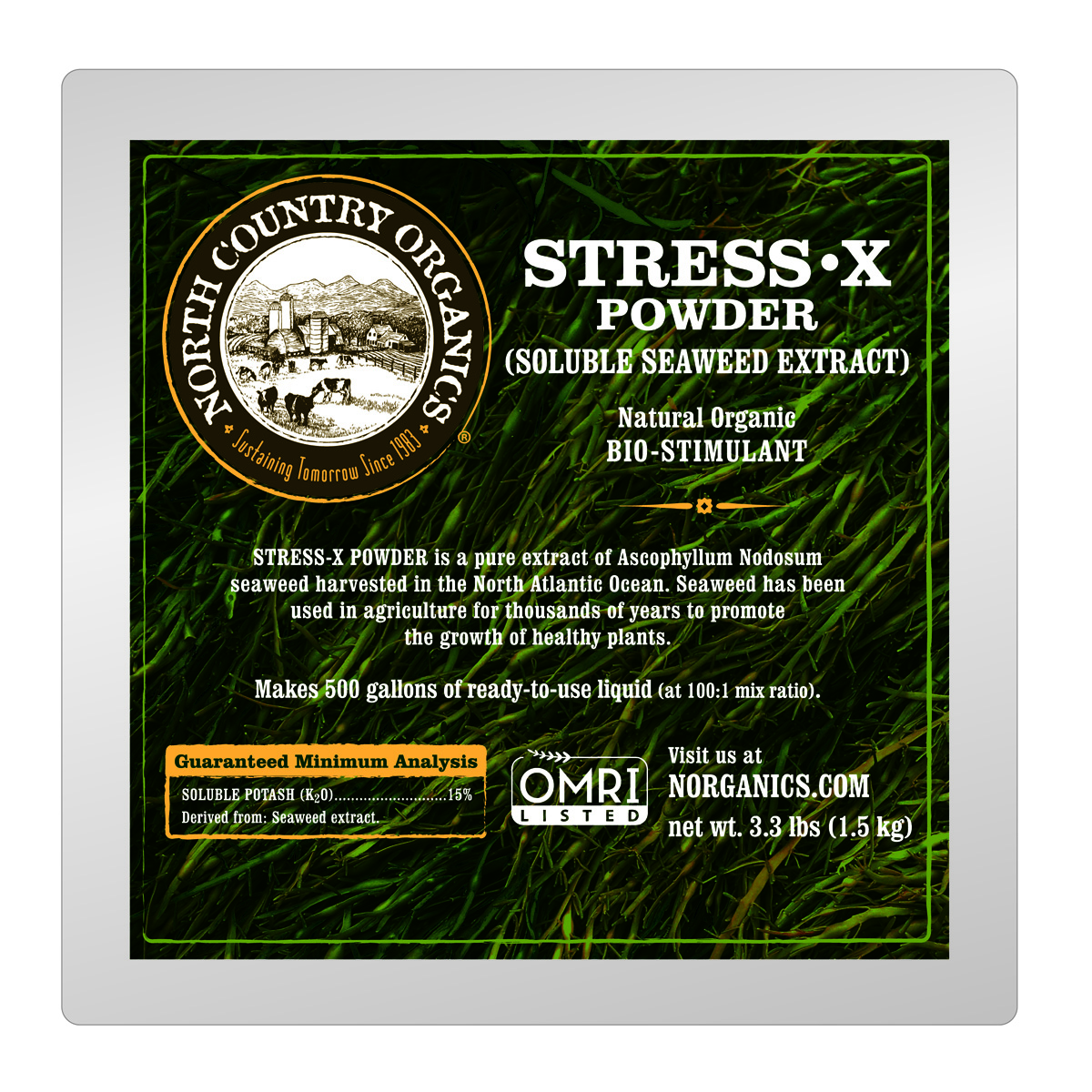

Stress-X is a soluble Ascophyllum nodosum seaweed extract. It provides plants with trace elements and natural growth hormones that greatly improve health, growth, and resistance to stress related problems.
There are 16 trace elements considered essential to plant life; few, if any, are available in conventional fertilizers. Most soils have an abundance of these micronutrients, but they are in rock mineral formations that are relatively unavailable to plants. The trace minerals in seaweed are naturally chelated (bonded) within organic compounds that are more easily broken down by plant and soil systems. Plants are very sensitive to doses of trace elements and there is a fine line between too much and not enough. Seaweed, like other living plants, contains a natural balance of these elements, making it an ideal supplement. Seaweed also contains mannitol, a natural chelating agent that can “unlock” unavailable minerals from the soil.
Trace minerals are a relatively small benefit from using Stress-X compared to the advantages from its growth hormone content. Natural hormones such as cytokinins, gibberellins, and auxins help plants in numerous ways:
- STRESS: Research has shown that plants treated with seaweed extract are less susceptible to environmental stress conditions. In many cases, trial plants still grow under extremely stressful conditions. Tests show greatly enhanced resistance to stress from drought, heat, and from internal physiological stress such as germination and flowering. Recent research shows this to be especially true for recreational turf.
- GROWTH AND DEVELOPMENT: Experiments have proven that seaweed significantly improves the growth and development of all parts of a plant, from the roots to the flowers. Some tests show increases of 2-3 times the root dry matter content compared with control plants (those plants not treated).
- SEED GERMINATION: In all cases tested, the speed of germination and the percentage of seeds germinated were significantly increased whenever seaweed extract was applied.
- DISEASES: Scientists have noted that seaweed, due to its cytokinin content, positively affects the resistance of plants to diseases. The applied cytokinins apparently allow the plant time to increase its resistance to the disease.
- INSECTS: As early as the 1940’s, there were reports that the hormones in seaweed could be valuable in controlling certain insect pests. Experiments have shown that seaweed can increase certain plants’ resistance to aphids, flea beetles, mites and nematodes. Non-scientific trials noted increased resistance to other insect species as well.
- SHELF LIFE: Research on various types of fruits and vegetables grown with applications of seaweed extract indicate a significantly longer shelf life than the controls with which they were compared.
- SENESCENCE: It is suggested that the hormones in seaweed inhibit senescence (aging) of plants and their produce. Inhibiting the rate at which a plant ages has incredible implications including greater production, longer ornamental value and increased propagation potential. Seaweed has been shown to increase the lifespan of annuals and decrease the dormancy period of most perennial plants.
- ROOTING: Scientists report that root growth is significantly improved whenever seaweed extract is applied, whether as a foliar spray or applied to the soil or rooting media. It has also been shown to accelerate absorption of plant nutrients by root systems.
- CHELATION: Seaweed contains mannitol, a natural chelating agent that has been shown to make available micronutrients within the soil that would otherwise be inaccessible.
- SUGAR CONTENT: Experiments have shown significant increases in sugar content of various fruits and vegetables from applications of seaweed extract.
- ENZYMES: Seaweed extract provides micronutrients essential to plants for the production of catalytic enzymes. These enzymes are critical in almost every function of a living plant from photosynthesis to reproduction.
In addition to all these benefits, Stress-X is biologically active and when introduced to the soil it stimulates the procreation of beneficial microorganisms. The result is accelerated growth, increased fruiting and flowering, intensified coloration, and significantly less need for pest and disease controls.
APPLICATION GUIDE
Suggested rates and dosages are approximate and may vary depending on the climatic region, soil type, and fertility. Additional applications can be made immediately prior to or following stress periods such as frost or drought. It is preferable to increase the frequency of applications rather than the concentration of the solution. Lower dilution rates should be applied to less dense foliage. Increase to higher rates as foliage matures. Soil drenches are preferable to foliar applications, where practical, as Stress-X will stimulate soil biological activity in addition to plant growth. Application rates are expressed in ounces (weight) of powder.
Fruit
Dosage per Acre per Application Foliar Application Stages
1st 2nd 3rd 4th Optional
Apples, Pears 8-12 oz Green tip(tight cluster) Pre-bloompink bud Full bloom Early fruit formation Every 21 days until harvest
Citrus 15-18 oz Early bloom Petal fall With summer spray With fall spray 6-9 weeks prior to harvest
Grapes 8-12 oz At 8-12 in. cane At 18-24 in. cane Full bloom Berry set – early shattering 2-3 weeks later
Stone Fruit 12-15 oz Pink or white bud Full bloom Early fruit formation 3 weeks later 3 weeks later
Strawberries: Annual Crop-Perennial Crop 8-12 oz Prior to transplant At first bloom At first fruit set Every 3-4 weeks to mid-point in harvest season
8-12 oz Early spring growth
Vegetables
Dosage per Application 8-12 oz /Acre per application Foliar Application Stages
1st 2nd 3rd Optional
Beans, Peas At 4-6 leaf stage At first bloom At first pods
Carrots, onions, leeks, turnips 2-3 weeks after emergence At root enlargement Every 10-14 days until harvest
Broccoli, cauliflower, cabbage At 4-6 true leaf stage 10-14 days later At head initiation
Sweet corn At 2-6 leaf stage 20-30 in. growth stage Just prior to tasselling
Cucumbers, pickles At 1st 4 true leaves First pre-bloom 7-14 days later Within 40 hrs of each picking
Eggplants, peppers, melons, squash At 0-8 in. growth Pre-bloom stage At fruit set Within 48 hrs of each picking
Greens At 4 leaf stage Regularly every 14 days
Potatoes At tuber set 10-14 days later Early bloom
Tomatoes (fresh market varieties) At 6-8 in. growth At pre-bloom At fruit set Within 48 hrs of each picking
Tomatoes (processing varieties) At 6-8 in. growth At pre-bloom At fruit set 14 days later
Turf
Dosage per application Start foliar applications at initial growth stage and continue at 3-4 week intervals. Make additional applications after periods of stress or heavy use, to newly applied sod and as a late season spray to help improve resistance to winter-kill and frost damage.
8-12 oz
Greenhouse Injection Systems
Dosage per application Mix dose in one gallon of water and inject at a dilution rate of 100:1. Apply every 3-4 weeks or after periods of stress.
8-12 oz
Trees, Shrubs, And Perennials
For Transplants, mix 1 oz. per 10 gallons of water and drench the root-ball before planting. Soak bare rootstock in the mixture for 20 minutes before planting. For established plants soak the ground under the drip-line or foliar feed a mixture of 1 oz. per 15 gallons of water.
General Information
1.5 Kg (1500 gr) of Stress-X Powder is equivalent to 5-gallons of liquid concentrate. At a 100:1 mixing ratio, this will treat two acres for a growing season.
Before adding to the tank, dissolve powder in a small amount (¼ – 3 gallons) of warm water before adding the slurry to the amount of water needed to make a ready-to-use (RTU) dilution. NCO recommends using approximately 900 gr (~32 oz) of powder per acre per year but no more than 300 gr (~10½ oz) per acre per application. If more than 3 applications are intended, divide the number of intended applications into 900 gr. The answer is the amount to use per application. Example: Customer wants to spray every other week for 12 weeks (total number of applications = 6). 900 ÷ 6 = 150 gr. So we would recommend using 150 gr (~5¼ oz) of powder per acre per application mixed in enough water to adequately cover the area. Do not use more than 1200 gr (~42 oz) of powder per acre per year. There is no danger of over-dosing; however, any more than that is not economical. When in doubt, use 3 gr (1 teaspoon) of powder in 1 gal water. This is a 100:1 mix ratio.
When using a greenhouse injector, dissolve 10.6 oz (300 gr) of powder per gallon of water and inject at 100:1. To calculate other mixing ratios, use the form below.
STRESS-X Powder Needed To Make A Ready-To-Use (RTU) Dilution
OMRI LISTED™ – View OMRI Certificate
For more information, download the product label pdf.
Stress X – View MSDS (pdf)